Showing posts with label Germany. Show all posts

Sunday, March 26, 2023

Rifle Drill of Wehrmacht Soldiers


Rifle drill in a German Wehrmacht pioneer replacement battalion. It was a challenge to keep the white drill uniform (Drillichzug) pristine and over time they took on a dingy faint greyish or yellowish tint to signify an old hand, an alten Landser ('old salt'). In 1940 reed green Drillichzugen began to be issued and the old white outfits became even more of a sign of veterans. The drill uniform was devoid of Lametta (tinsel), that is, insignia and adornments. Recruits did a great deal of rifle drill which improved physical fitness, stamina, coordination, and familiarity with the rifle, here Mauser Kar.98b 'carbines' issued to training and other second-line units. Being pioneers, they sometimes conducted such drills with shovels. Their Obergefreiter, wearing Drillichhose, drills them relentlessly, harassing them with Schikanen (nasty tricks). In the background is a Hf.1 light field wagon* with each Pionierezug possessing one for its equipment, which could weigh up to 1,360kg. Most wagons had smaller front wheels, but German military wagons used the same sized large wheels on all axels requiring only one size for replacements.

* Hf. = Heersfahrzeug (Army vehicle).

Source :
"German Pionier 1939-45: Combat Engineer of the Wehrmacht" Gordon L. Rottman & Carlos Chagas

Monday, March 20, 2017

The Berlin Congress


Title: Der Berliner Kongreß 1878 (The Berlin Congress, 1878)
Artist: Anton von Werner
Date: 1881

 At the height of the socialist scare in the early summer of 1878, international affairs also demanded Bismarck’s attention. The Berlin Congress was convened from June 13 to July 13, 1878, as an international meeting to solve the Balkans question in the wake of the Russo-Turkish War of 1877-78. Bismarck offered his services as an “honest broker” [ehrlicher Makler], thereby scoring a major diplomatic triumph. Originally, the Berlin senate hoped to organize a festive reception to mark the conclusion of the congress. But when the plan went awry, it used the allocated money to commission this painting from Anton von Werner (1843-1915). On March 22, 1881, the Kaiser’s 84th birthday, the artist presented the painting to the Berlin city fathers. Werner’s painting highlights a number of important participants in the congress, including British Prime Minister Benjamin Disraeli (1804-1881), seen at the left. The real focus of the viewer’s attention, however, is the trio in the immediate foreground, and, even more specifically, the handshake between Bismarck and the second-ranking Russian diplomat in attendance, Count Pyotr A. Schuvalov (1827-1889). The Austro-Hungarian representative, Count Gyula Andrássy (1823-1890), looks on. That Schuvalov enjoyed such good relations with Bismarck angered the leader of the Russian delegation, Prince Alexander M. Gorchakov (1798-1883) (seated at the left), who subsequently ensured that his career went downhill. Among the men standing at far right are Lord Salisbury, the British foreign secretary, and Lord Odo Russell, the British ambassador in Berlin (third and fourth from the end, respectively). The foreground handshake was partially orchestrated by the artist himself, who wanted the viewer to be able to focus on a relatively intimate group, as opposed to an undifferentiated collection of diplomats. But this still did not prevent critics from complaining that Werner had painted only a “cabinet of wax figures.” Werner had even suggested the setting, for the room in which the handshake took place was better lit than the one in which the main negotiations were held. 


Source:
https://commons.wikimedia.org/wiki/File:Congress_of_Berlin,_13_July_1878,_by_Anton_von_Werner.jpg
http://germanhistorydocs.ghi-dc.org/sub_image.cfm?image_id=1419

Monday, October 3, 2016

In the Troops Quarter Outside Paris


Title: Im Etappenquartier vor Paris (A Billet outside Paris)
Artist: Anton von Werner
Date: 24 October 1870 - 1894

This painting by Anton von Werner (1843-1915) was completed in 1894 and purchased the same year by the National Gallery in Berlin (surprisingly, it was the first Werner painting the National Gallery acquired). The sketch forming the basis of his painting, however, had been executed twenty-four years earlier: on October 24, 1870, when the artist was accompanying Chief of the Prussian General Staff Helmuth von Moltke (1800-1891) and his entourage in occupied France. The finished work shows German troops occupying the Château de Brunoy outside Paris during the Franco-Prussian War. To be sure, Werner documents every detail of the scene and the setting – right down to the inexpertly repaired boot sole at the right. But his principal aim is to emphasize the contrast between the vigorous, ruddy-cheeked troops, with their practical mud-covered footwear, and the sumptuous, effeminate interior they have requisitioned for temporary lodgings. This contrast is conveyed not least by Werner’s palette – the soldiers, dressed in blue uniforms with red piping, are rendered in dark primary colors, thereby standing out against an interior awash in pastels and dominated by the warm yellow of gilded surfaces. In this and other pictorial choices, Werner seems to suggest German cultural superiority over the French. For example, the soldiers have not, as in the age-old manner, destroyed the furniture at hand to light a fire and revenge themselves on the enemy; instead, they have taken the time to gather wood on the villa’s grounds, seen just outside the window at rear. And while the soldiers look dirty and rumpled, they are not necessarily rough-hewn. In fact, they have enough good German Bildung – education and “cultivation” – to play the piano and give voice to song in an impromptu concert. (According to Werner’s notes, they were singing Franz Schubert's setting of Heine's poem “Das Meer erglänzte weit hinaus” [“The Sea Shone Resplendent far into the Distance”], which, as he added, was very popular with all the military bands at that time). This history lesson would not have been lost on German viewers of the painting in 1894. Nevertheless, it would be wrong to portray Werner’s politics as illiberal or chauvinist. He had no need to make the enemy appear despicable: except for the villa’s female concierge and her daughter, who appear to be suffering none of the hardships inflicted upon the Parisian population at the time, the French have simply disappeared from the scene. The mood of good humor is further reinforced by the elaborate clock and vases on the mantle – their very presence suggesting that no looting has been committed by the occupying troops. These choices make the painting even more melodramatic and contrived, undercutting its apparently disinterested virtuosity. What conclusions do we draw from this? On the one hand, the very fact that patriotic painting of this sort had achieved such popularity by the 1890s may indicate that, by the turn-of-the-century, the chauvinism so vehemently criticized by Friedrich Nietzsche after 1871 had evolved into something that was, if not more generous to French victimhood or forgiving of German brutality, then at least more innocuous. Tellingly, when contemporary viewers commented upon Werner’s portrayal of soldiers lounging disrespectfully on the furniture of a beautiful French château, they found this aspect amusing, not offensive. On the other hand, such public reaction may reflect the philistine complacency that Nietzsche also identified as characteristic of post-unification German society. 


Source :
http://germanhistorydocs.ghi-dc.org/sub_image.cfm?image_id=1400

Wednesday, February 17, 2016

Panzer IV Ausf.F1/G/H Medium Tank in Battle


Title: Panzer IV Ausf.F1/G/H medium tank
Artist: Unknown
Date: Unknown

Whilst the propaganda headlines may well have gone to the big cats such as the Panther and the Tiger, the Panzer IV was the backbone of German armoured capability throughout the war. The iconic German tank of the Second World War, the Panzer IV fought from the invasion of Poland to the fall of Berlin. The Panzer IV was constantly updated, with its sound design giving it a longevity well beyond that of its contemporaries. By mid-war it was packing a deadly long-barrelled 75mm gun, giving it great hitting power and better mobility and its armour had been doubled in places greatly increasing its survivability.

By the time of massive battles in Russia in middle of the war the Pz IV was also carrying the detachable screen side armour known as schürzen. This was in response to the threat posed by Russian anti-tank rifles and, latterly, by Allied hollow charge bazooka style weapons.

This is the backbone of the Panzer regiments!


Source :
http://store.warlordgames.com/products/panzer-iv-plastic-box-set

Monday, February 15, 2016

War Enthusiasm at the Start of World War I (1914)


Title: 1 August 1914 in Berlin
Artist: Arthur Kampf
Date: 1914

Russia mobilized his troops against Austria-Hungary on 31 July 1914. The Germans responded on the evening of 1 August 1914 with the mobilization of its troops. This painting by Arthur Kampf (1864-1950), entitled '1. August 1914 in Berlin' (1914) captures the moment between the two mobilization. Before a crowd in Berliner Schloss, a man has climbed to a lamppost with the Empire flag in his left hand and speaks to the crowd. This painting is now currently displayed at the German Historical Museum, Berlin.


Source :
http://germanhistorydocs.ghi-dc.org/sub_image.cfm?image_id=1716&language=german

The Last Statement in Front of the Police Officer (1886)


Title: Die Letzte Aussage (The Last Statement)
Artist: Arthur Kampf
Date: 1886

While still a student at the Kunstakademie Düsseldorf, Arthur Kampf produced a painting that caused a real stir on account of its size coupled with its theme. The subject of controversy in the dailies and the trade journals, the work won many prizes and, after first going on display in 1886 was very popular and laid the foundations for his career. The socially critical depiction of a man fatally injured, whose last statement is being jotted down by a policeman as he lies dying, was firmly in the tradition of ‘painting poor people’ that emerged in the second half of the 19th century. The artist to great effect intermingles the scene of the realistically portrayed man dying with representational motifs drawn from Christian art, constructing a pictorial space with life-size figures. One stands opposite them and becomes the witness of the dramatic events. From the 1890s onwards, Arthur Kampf emerged as one of Germany’s most important history painters of his day, and his works were widely received in Germany through 1945. (Sabine Schroyen)


Source :
https://www.google.com/culturalinstitute/asset-viewer/the-last-statement/YAF8GuTQzOD0Ig?hl=en

German Soldiers in a French Church (1915)


Title: Karfreitag in einer französischen Kirche (Good Friday in a French Church)
Artist: Arthur Kampf
Date: 1915

Also known as 'Wir treten zum Beten vor Gott den Gerechten' ('We gather together to ask the Lord's blessing'). This painting was created in 1915, once hung in the Great German Art Exhibition of 1939, Saal 03. Nowadays it is in the possession of the Staatliche Museen zu Berlin, Preusischer Kulturbesitz, Nationalgalerie.

'Wir treten zum Beten' is an old prayer song with Dutch origins going back to the Battle of Turnhout in 1597, where the Dutch defeated the Spaniards. The song was very popular during the time of the German Kaiserreich. Later, the National Socialists used the song often in their propaganda. It would emphasise the blessing of God on the Third Reich as successor of the German Kaiserreich.


Source :
http://www.germanartgallery.eu/mobile/Webshop/0/product/info/Arthur_Kampf,_Good_Friday&id=42

Sunday, February 14, 2016

Public Viewing of the Corpse of Kaiser Wilhelm I (1888)


Title: Die Aufbahrung Kaiser Wilhelm I (The body of Kaiser Wilhelm I lying in state)
Artist: Arthur Kampf
Date: 1900

Also known as 'Aufbewahrung Kaiser Wilhelm I. im Berliner Dom' (Public Viewing of the Corpse of Kaiser Wilhelm I. in the Dome in Berlin). Displayed at the Grosse Münchener Kunstausstellung in the Glaspalast, 1922. In the possession of the Neue Pinakothek, Munich 


Source :
http://www.germanartgallery.eu/en/Webshop/0/product/info/Arthur_Kampf,_Mit_Mann_und_Ross_und_Wagen&id=209

German Soldier Bandaging his Wrist (1940)


Title: Nach dem Kampf (After the battle)
Artist: Ernst Kretschmann
Date: 1940

This original poster from 1940 depicts a brave German soldier, aware of his duty, who is bandaging his wrist. In the distance is the chaos of the battle field: smoking ruins and canons. On the backside of this period print is adhered the newspaper “Vossische Zeitung” from 1933. The leading article concerns the Reichtag fire which happened only a day earlier. Vossische Zeitung, founded in 1704, was a Berlin-based liberal newspaper. In 1934, a year after this edition, Vossische Zeitung was forced by the Nazis to close down. The Reichstag fire (27 February 1933) was an arson attack on the Reichstag building in Berlin that occurred on 27 February 1933. The event is seen as pivotal in the establishment of Nazi Germany. The fire was used by the Nazis as evidence that the Communists were beginning a plot against the German government. Suspending civil liberties, the government instituted mass arrests of Communists, including all of the Communist parliamentary delegates. With their bitter rivals the Communists gone and their seats empty, the National Socialist Party went from being merely a plurality party to the majority. The poster is signed “EK 40, Nach dem Kampf” (partially under the frame).

Ernst Kretschmann (1897–1942) was a German illustrator, graphic designer and SA-Truppführer (Nazi storm trooper with the rank of sergeant first class). In 1912 the son of a railroad worker studied at the Architektenschule in Mainz. In 1915 Kretschmann voluntarily joined the army. As part of a Stosstrupp he took part in 34 battles and was wounded at Verdun. From 1921 to 1931 he made study trips within Europe and to Morocco, Spanish-East Africa and the Canary Islands. In this time, as a self taught graphic artist, he made many illustrations for the fashion industry. As an employee of the magazines ‘Die SA’ and ‘Der SA-Führer’, Kretschamnn made many propaganda illustrations for the National Socialists. In the Great German Art Exhibitions Kretschmann was represented -until his death- with four works. As a SA-Truppführer from a propaganda company he fell in 1942 at the Eastfront.


Source :
http://www.germanartgallery.eu/en/Webshop/0/product/info/Ernst_Kretschmann,_Nach_dem_Kampf&id=37

Tuesday, February 9, 2016

Prussian Crown Prince Friedrich-Wilhelm with His Family


Title: Crown Prince Friedrich-Wilhelm with his wife, Crown Princess Victoria, and their children, Prince Wilhelm and Princess Charlotte.
Artist: Franz Xaver Winterhalter
Date:1862

Crown Princess Victoria is dressed in an opulent evening dress. She was presumably expecting Prince Heinrich who arrived on 14 August of that year.


Source :
http://www.gogmsite.net/early_victorian_-_1837_-_18/princess_royal_victoria/princess-royal-victoria/1862_emperor_frederick_iii_.html

Sunday, February 7, 2016

Prince Albert of Saxe-Coburg and Gotha


Title: Prince Albert of Saxe-Coburg and Gotha
Artist: Franz Xaver Winterhalter
Date: 1842

Prince Albert of Saxe-Coburg and Gotha wearing the Golden Fleece, painted by Franz Xaver Winterhalter in 1842. Commissioned by Queen Victoria, it is perhaps unsurprising that this early portrait was one of Queen Victoria’s three favourite pictures of her husband, given the artist’s romantic treatment of the subject. Prince Albert is depicted in officer’s undress uniform, standing in a noble pose set against stormy skies, in a manner evocative of Ingres.


Source :
https://www.royalcollection.org.uk/eGallery/object.asp?maker=12557&object=401412&row=1&detail=about

Thursday, February 4, 2016

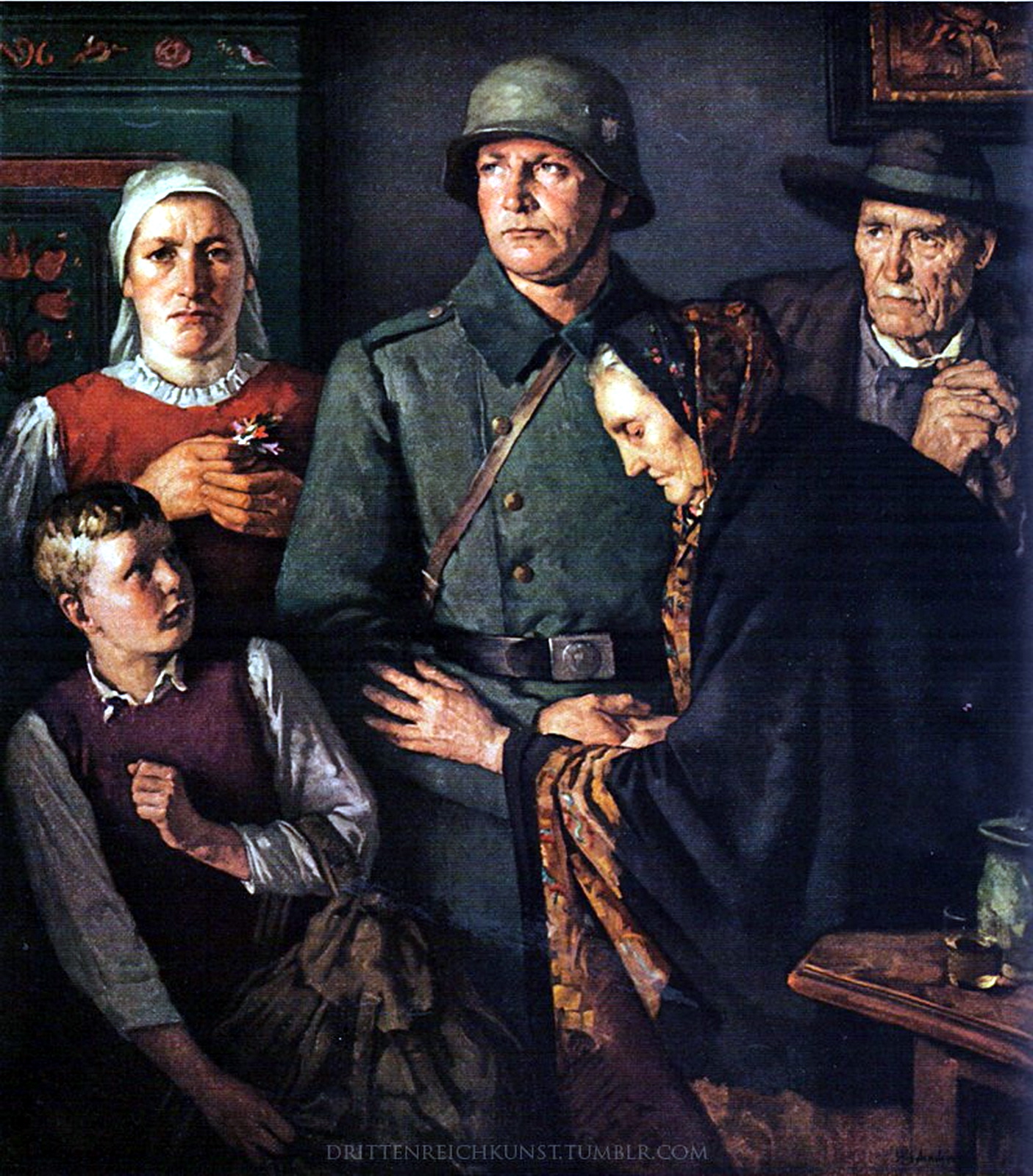
The Austrian Peasant Family


Title: Ostmärkische Bauernfamilie (The Austrian Peasant Family)
Artist: Hans Schachinger
Date: 1941

In this extraordinary painting, no family members make eye contact, not even with the soldier-son who is the centerpiece of the composition. Generations rarely mix. So complete was the visual segregation between masculine and feminine spheres that gender was "color coded" in Nazi arts, with blues predominating for females and browns or blacks delineating males.


Source :
Book "Landscaping the Human Garden: Twentieth-century Population Management in a Comparative Framework" by Amir Weiner