Showing posts with label 1900s. Show all posts

Sunday, March 26, 2023

Rifle Drill of Wehrmacht Soldiers


Rifle drill in a German Wehrmacht pioneer replacement battalion. It was a challenge to keep the white drill uniform (Drillichzug) pristine and over time they took on a dingy faint greyish or yellowish tint to signify an old hand, an alten Landser ('old salt'). In 1940 reed green Drillichzugen began to be issued and the old white outfits became even more of a sign of veterans. The drill uniform was devoid of Lametta (tinsel), that is, insignia and adornments. Recruits did a great deal of rifle drill which improved physical fitness, stamina, coordination, and familiarity with the rifle, here Mauser Kar.98b 'carbines' issued to training and other second-line units. Being pioneers, they sometimes conducted such drills with shovels. Their Obergefreiter, wearing Drillichhose, drills them relentlessly, harassing them with Schikanen (nasty tricks). In the background is a Hf.1 light field wagon* with each Pionierezug possessing one for its equipment, which could weigh up to 1,360kg. Most wagons had smaller front wheels, but German military wagons used the same sized large wheels on all axels requiring only one size for replacements.

* Hf. = Heersfahrzeug (Army vehicle).

Source :
"German Pionier 1939-45: Combat Engineer of the Wehrmacht" Gordon L. Rottman & Carlos Chagas

Tuesday, January 29, 2019

Private Afghan Army 1980


Title: Private Afghan Army (Afghanistan l980)
Artist: Chris McNab
Date: 2002

As this soldier demonstrates, the troops of the Afghan Army were ill equipped to fight the highly motivated Mujahedeen guerrillas during the Soviet Union's 10-year occupation of Afghanistan. The standard grey-drab combat uniform and soft-peaked cap provided scant protection from the severe Afghan weather, and gave a poor appearance on the parade ground (it doubled as parade kit). The webbing is of local manufacture from cheap leather, and the civilian belt has an inadvisably shiny gold buckle which could be an aiming point for a sniper. The rifle is the venerable Mosin-Nagant 7.62mm (0.3in) M1944 carbine, a weapon with origins back to 1888 and, by 1980, hopelessly outdated against the AK series rifles. Canvas gaiters, worn to protect against mud and water intrusion, feature mud-reinforced black leather sections. Afghan soldiers were inconsistently equipped throughout the conflict.


Source :
Book "20th Century Military Uniforms" by Chris McNab

Private Abyssinian Patriot Army (Ethiopia 1941)


Title: Private Abyssinian Patriot Army (Ethiopia 1941)
Artist: Chris McNab
Date: 2002

Abyssinia fell under italian control in 1935 after an invasion from the Italian territories of Somaliland and Eritrea. With the onset of World War II, the Italians thus used Abyssinia as a jumping-off point for their East African campaigns into the Sudan and Kenya, However, resistance from Abyssinian patriots and an effective British campaign in the region returned Abyssinia to its own control in May 1941. The soldier pictured here is one of the Abyssinian resistance fighters who fought alongside the Allies. There was no uniform as such, the patriots usually utilizing whatever items of European clothing were available. This soldier has a khaki tunic and pantaloons, probably of pre-war italian or German origin, worn with canvas leggings, but no boots. The riffe is the German 7.62aum (0.3in) 98K, and a péstol hangs from his leather belt.


Source :
Book "20th Century Military Uniforms" by Chris McNab

Wednesday, February 17, 2016

Panzer IV Ausf.F1/G/H Medium Tank in Battle


Title: Panzer IV Ausf.F1/G/H medium tank
Artist: Unknown
Date: Unknown

Whilst the propaganda headlines may well have gone to the big cats such as the Panther and the Tiger, the Panzer IV was the backbone of German armoured capability throughout the war. The iconic German tank of the Second World War, the Panzer IV fought from the invasion of Poland to the fall of Berlin. The Panzer IV was constantly updated, with its sound design giving it a longevity well beyond that of its contemporaries. By mid-war it was packing a deadly long-barrelled 75mm gun, giving it great hitting power and better mobility and its armour had been doubled in places greatly increasing its survivability.

By the time of massive battles in Russia in middle of the war the Pz IV was also carrying the detachable screen side armour known as schürzen. This was in response to the threat posed by Russian anti-tank rifles and, latterly, by Allied hollow charge bazooka style weapons.

This is the backbone of the Panzer regiments!


Source :
http://store.warlordgames.com/products/panzer-iv-plastic-box-set

Monday, February 15, 2016

War Enthusiasm at the Start of World War I (1914)


Title: 1 August 1914 in Berlin
Artist: Arthur Kampf
Date: 1914

Russia mobilized his troops against Austria-Hungary on 31 July 1914. The Germans responded on the evening of 1 August 1914 with the mobilization of its troops. This painting by Arthur Kampf (1864-1950), entitled '1. August 1914 in Berlin' (1914) captures the moment between the two mobilization. Before a crowd in Berliner Schloss, a man has climbed to a lamppost with the Empire flag in his left hand and speaks to the crowd. This painting is now currently displayed at the German Historical Museum, Berlin.


Source :
http://germanhistorydocs.ghi-dc.org/sub_image.cfm?image_id=1716&language=german

German Soldiers in a French Church (1915)


Title: Karfreitag in einer französischen Kirche (Good Friday in a French Church)
Artist: Arthur Kampf
Date: 1915

Also known as 'Wir treten zum Beten vor Gott den Gerechten' ('We gather together to ask the Lord's blessing'). This painting was created in 1915, once hung in the Great German Art Exhibition of 1939, Saal 03. Nowadays it is in the possession of the Staatliche Museen zu Berlin, Preusischer Kulturbesitz, Nationalgalerie.

'Wir treten zum Beten' is an old prayer song with Dutch origins going back to the Battle of Turnhout in 1597, where the Dutch defeated the Spaniards. The song was very popular during the time of the German Kaiserreich. Later, the National Socialists used the song often in their propaganda. It would emphasise the blessing of God on the Third Reich as successor of the German Kaiserreich.


Source :
http://www.germanartgallery.eu/mobile/Webshop/0/product/info/Arthur_Kampf,_Good_Friday&id=42

Sunday, February 14, 2016

German Soldier Bandaging his Wrist (1940)


Title: Nach dem Kampf (After the battle)
Artist: Ernst Kretschmann
Date: 1940

This original poster from 1940 depicts a brave German soldier, aware of his duty, who is bandaging his wrist. In the distance is the chaos of the battle field: smoking ruins and canons. On the backside of this period print is adhered the newspaper “Vossische Zeitung” from 1933. The leading article concerns the Reichtag fire which happened only a day earlier. Vossische Zeitung, founded in 1704, was a Berlin-based liberal newspaper. In 1934, a year after this edition, Vossische Zeitung was forced by the Nazis to close down. The Reichstag fire (27 February 1933) was an arson attack on the Reichstag building in Berlin that occurred on 27 February 1933. The event is seen as pivotal in the establishment of Nazi Germany. The fire was used by the Nazis as evidence that the Communists were beginning a plot against the German government. Suspending civil liberties, the government instituted mass arrests of Communists, including all of the Communist parliamentary delegates. With their bitter rivals the Communists gone and their seats empty, the National Socialist Party went from being merely a plurality party to the majority. The poster is signed “EK 40, Nach dem Kampf” (partially under the frame).

Ernst Kretschmann (1897–1942) was a German illustrator, graphic designer and SA-Truppführer (Nazi storm trooper with the rank of sergeant first class). In 1912 the son of a railroad worker studied at the Architektenschule in Mainz. In 1915 Kretschmann voluntarily joined the army. As part of a Stosstrupp he took part in 34 battles and was wounded at Verdun. From 1921 to 1931 he made study trips within Europe and to Morocco, Spanish-East Africa and the Canary Islands. In this time, as a self taught graphic artist, he made many illustrations for the fashion industry. As an employee of the magazines ‘Die SA’ and ‘Der SA-Führer’, Kretschamnn made many propaganda illustrations for the National Socialists. In the Great German Art Exhibitions Kretschmann was represented -until his death- with four works. As a SA-Truppführer from a propaganda company he fell in 1942 at the Eastfront.


Source :
http://www.germanartgallery.eu/en/Webshop/0/product/info/Ernst_Kretschmann,_Nach_dem_Kampf&id=37

Monday, February 8, 2016

Afghan War


Title: Afghan War
Artist: Unknown
Date: Unknown

Soviet convoy ambushed by the Mujahideens. The Soviet–Afghan War lasted over nine years from December 1979 to February 1989. Insurgent groups ("the Mujahideen") who received aid from both Christian and Muslim countries, fought against the Soviet Army and allied Afghan forces. Between 850,000–1.5 million civilians were killed and millions of Afghans fled the country as refugees, mostly to Pakistan and Iran.


Source :
http://www.favewallpapers.com/73577-diorama-afghanistan-battle-militants-soviet%20troops.html

Sunday, February 7, 2016

A Time to Heal


Title: A Time to Heal
Artist: Don Stivers
Date: 2014

In early winter of 7 November 1944, in the mist-shrouded forests of Hürtgen on the Belgium-German border, the first of one of the most heroic and humanitarian truces of the Second World War was forged between Allied Commanders and their counterparts when doctors and medics from both sides of battle converged to retrieve their wounded comrades during a cessation of arms.


Source :
http://www.ebay.co.uk/itm/Don-Stivers-A-TIME-TO-HEAL-Artist-Proof-AP-Medic-World-War-Wall-Hanging-Art-Gift-/261499850284

Thursday, February 4, 2016

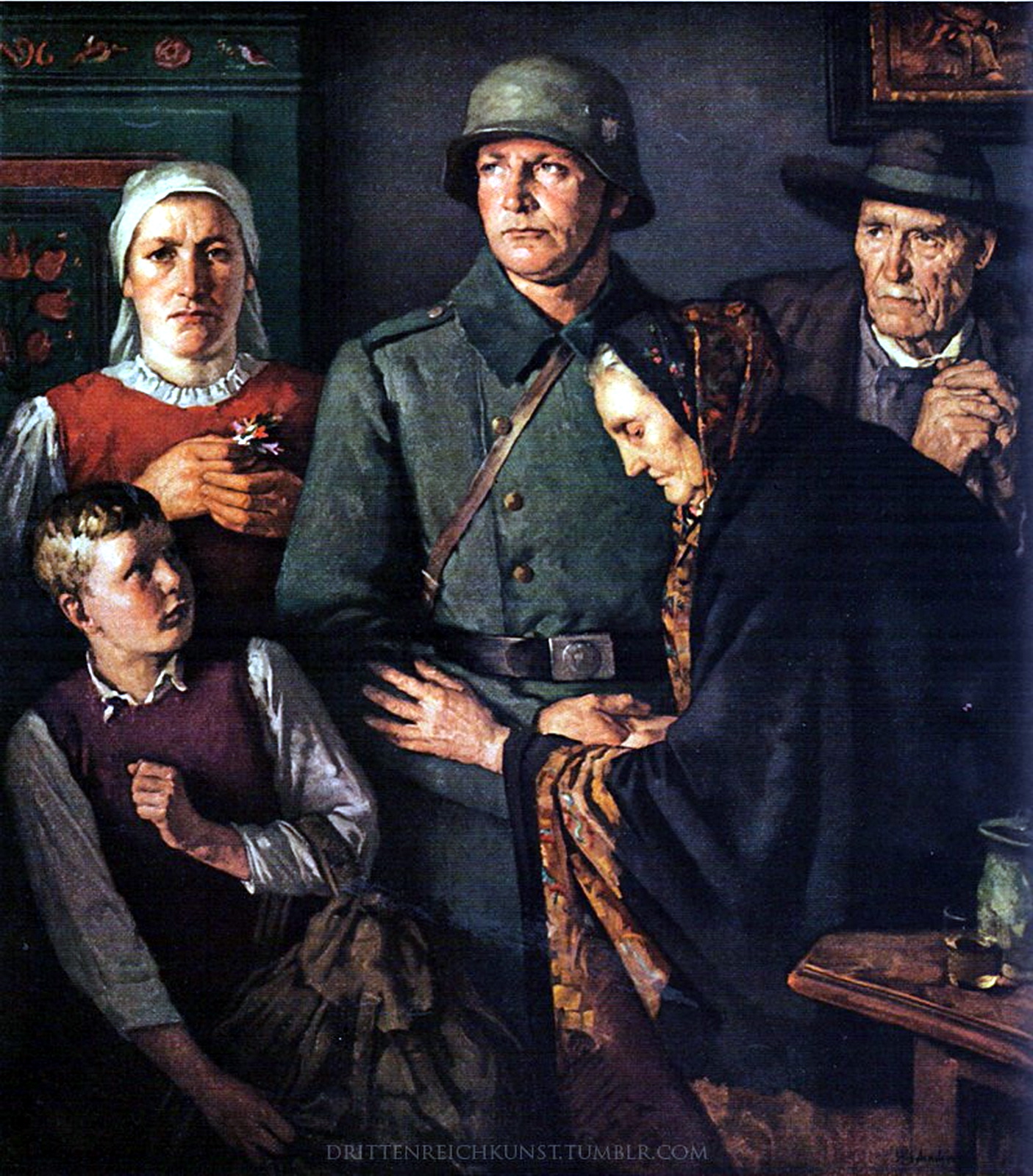
The Austrian Peasant Family


Title: Ostmärkische Bauernfamilie (The Austrian Peasant Family)
Artist: Hans Schachinger
Date: 1941

In this extraordinary painting, no family members make eye contact, not even with the soldier-son who is the centerpiece of the composition. Generations rarely mix. So complete was the visual segregation between masculine and feminine spheres that gender was "color coded" in Nazi arts, with blues predominating for females and browns or blacks delineating males.


Source :
Book "Landscaping the Human Garden: Twentieth-century Population Management in a Comparative Framework" by Amir Weiner